




The Neuroscience of Manifestation: How Your Subconscious Actually Shapes Your Reality
Manifestation gets talked about in a lot of ways.
Some of it is powerful. Some of it is helpful. Some of it gets so vague and mystical that it becomes almost impossible to explain without sounding like you’re floating six feet above your body.
I believe in manifestation.
I also believe we need a much better explanation of what is actually happening when someone “manifests” something.
Because manifestation is not just thinking about something until life magically hands it to you.
A lot of what people call manifestation can be explained through your brain, your subconscious mind, your nervous system, your identity, and your repeated behavior.
And for me, this matters.
I was raised in an environment where asking questions was often treated like a lack of faith. A lot of things got brushed off with some version of, “God’s ways are higher than ours,” which usually meant, “Stop asking. Stop thinking. Just accept it.”
So now, I care deeply about understanding how things work.
I do not believe mystery requires us to turn our brains off. I believe we can honor the spiritual side of life and still ask better questions, look at the science, understand the nervous system, and explain these concepts in a way that actually makes sense.
So let’s get into what is really happening underneath manifestation.
Your subconscious mind is constantly deciding what feels safe, familiar, possible, threatening, normal, and “like you.”
That matters because your life is not only shaped by what you consciously want.
It is shaped by what your subconscious believes you are available for, capable of, safe with, and allowed to have.
That is where manifestation starts to make a lot more sense.
“Manifestation” is not just a thought. It is a pattern.
Your subconscious is not sitting in the background quietly making suggestions.
It is running most of your automatic patterns.
It stores your beliefs, memories, emotional associations, fears, expectations, identity, and learned responses.
All day long, your brain is scanning your environment and asking questions like:
“Is this safe?”
“Have we experienced this before?”
“If so, how did it go? What should we be afraid of?”
“Do we know how to handle this?”
“Does this match what we believe about ourselves?”
“Could this lead to rejection, judgment, pressure, conflict, loss, or embarrassment?”
This is why you can consciously want one thing and still behave in a way that keeps you stuck in the opposite pattern.
Someone can want more money and still undercharge in their business.
Someone can want healthier relationships and still choose emotionally unavailable people.
Someone can want to be seen and still hide the moment attention comes their way.
Someone can want consistency and still quit the second they miss one day.
This is not a character flaw.
It is usually a protection pattern.
Your brain is always trying to keep you in familiar territory. The problem is that familiar does not always mean healthy, good, or aligned.
Familiar just means your brain knows what to expect there.

So how does your subconscious “attract” situations?
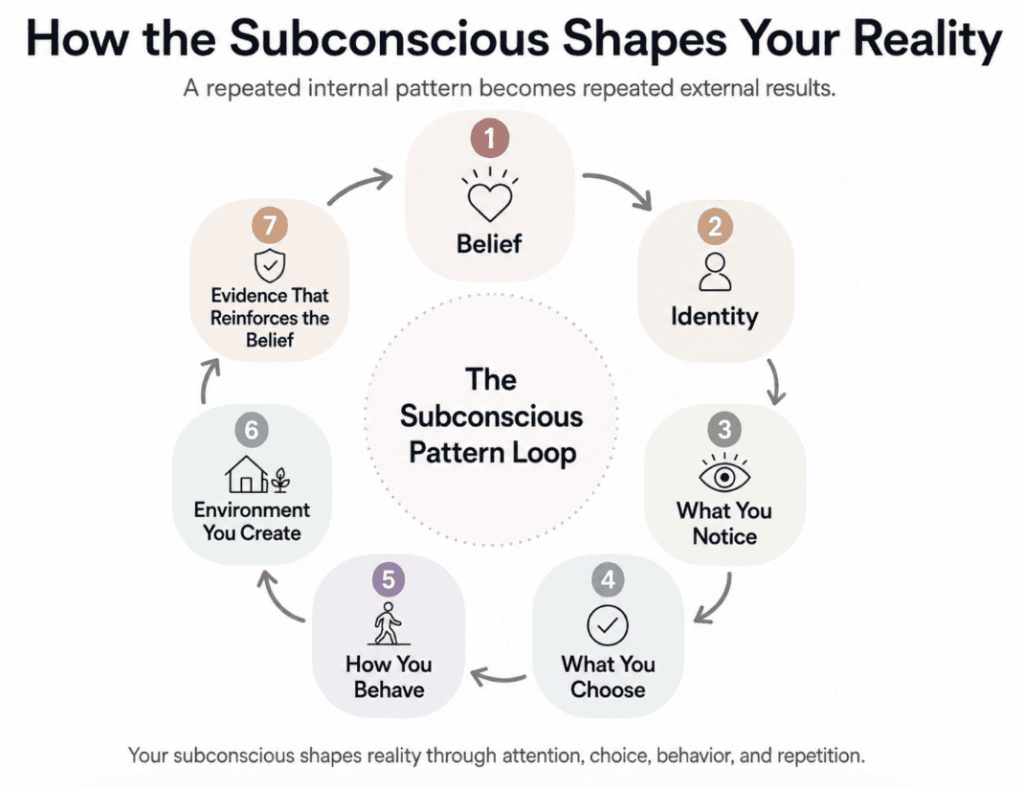
Your subconscious shapes your reality through what you notice, what you avoid, what you choose, what you tolerate, what you repeat, and what you make normal.
That is the real attraction loop.
This is also where practices like prayer can come in.
From a scientific perspective, prayer is not something we can prove as a guaranteed force that rearranges external events. But prayer can absolutely affect the internal state of the person praying.
Prayer can focus your attention. It can calm your body. It can help you name what you want, what you fear, what you need to release, and what you are choosing to trust. It can move you out of panic and into steadiness. It can interrupt the old pattern long enough for you to make a different choice.
And different choices matter.
A belief creates an identity.
That identity affects what you notice.
What you notice affects what you choose.
What you choose affects how you behave.
How you behave affects the environment you create.
That environment then gives you more evidence for the original belief.
So your life can start to look like proof of what you already believe about yourself.
This is why subconscious work matters so much.
You are not only changing your thoughts.
You are changing the pattern that keeps creating the same experiences.
The money example: how limiting beliefs create real results

Let’s use money because this is where it gets very clear.
Imagine someone who owns a business has major limiting beliefs around money.
They believe things like:
“I can’t charge that much.”
“People won’t pay me.”
“I’m not worth premium pricing.”
“I should be grateful for any client.”
“Money is always inconsistent.”
“If I ask for more, people will leave.”
“I have to prove myself before I can be paid well.”
Those thoughts do not stay in the mind as random little ideas.
Over time, they become an identity.
That person starts seeing themselves as someone who has to work hard for less. Someone who should be grateful for scraps. Someone who is not fully safe being well-paid, respected, or chosen by high-quality clients.
Then that identity starts making business decisions.
They keep their prices low.
They over-explain the offer.
They avoid raising their rates.
They discount when no one asked for a discount.
They ignore red flags on sales calls.
They take clients who already feel like a problem (and end up paying late, being demanding, etc).
They avoid requiring payment upfront.
They feel awkward following up on missed payments.
They let payment issues slide because boundaries feel uncomfortable.
They resent clients but keep over-delivering.
Then they look at the situation and think, “Why do I keep attracting difficult clients?”
But if we slow it down, we can see the pattern.
Their subconscious beliefs about money, value, and being respected are shaping their pricing, messaging, sales process, payment policies, boundaries, and client selection.
The business becomes an environment where low-quality clients can get in, delay payments, push boundaries, and keep reinforcing the belief that money is hard.
That is not bad luck. And it is not mystical “manifestation.”
It is a subconscious pattern playing out through repeated choices, behaviors, standards, and tolerances until the results start matching the belief.
Where the Reticular Activating System comes in

The Reticular Activating System, or RAS, acts as the brain’s filter.
Your brain receives far more information than you can consciously process. So it has to sort, filter, and prioritize.
It pays attention to what it believes is relevant, important, familiar, or threatening.
This is why when you decide you want a specific car, you suddenly see that car everywhere.
The cars were likely already there. Your brain just started marking them as relevant.
The same thing happens with beliefs and identity.
If someone believes, “Money is hard,” their brain will filter for evidence that money is hard.
They will notice the client who did not pay.
They will replay the launch that did not work.
They will obsess over the unexpected bill.
They may completely miss the opportunity sitting right in front of them because their brain is busy scanning for problems, inconsistency, and proof that things are not working.
This is one reason “just think positive” does not work.
You are not trying to paste a positive thought on top of an old pattern.
You are training your brain to recognize a new reality as relevant, possible, and safe.
Manifestation and neuroplasticity

Neuroplasticity is your brain’s ability to change.
Your brain can build new pathways through repetition, emotion, learning, and experience.
This is one of the most grounded ways to understand manifestation.
When you repeatedly visualize a new outcome, rehearse a new identity, regulate your nervous system, interrupt an old response, and act in a different way, you are training your brain.
You are helping your system learn:
“This is safe.”
“This is familiar.”
“This is something I know how to hold.”
“This is part of who I am now.”
This is why practices like visualization, hypnosis, EFT, scripting, affirmations, and identity work can be so powerful when they are done in a grounded way.
They are not supposed to be random positive statements you repeat while your actual life stays the same.
They are tools for rehearsal.
You are rehearsing a new way of being until your brain and body stop treating it like a foreign concept.
When the new identity becomes more familiar, your behavior starts to shift with less force.
You do not have to constantly hype yourself up to do the thing.
It starts to feel more natural.
Your nervous system has to feel safe with what you want
This is one of the biggest missing pieces in most manifestation conversations.
You can want something consciously and still feel unsafe having it.
More money might feel like pressure.
Wealth might feel like greed.
Visibility might feel like judgment.
A healthy relationship might feel unfamiliar.
A better body might feel exposing (many women who have experienced sexual trauma subconsciously believe being more attractive will put them at risk for more).
A bigger business might feel overwhelming.
Success might feel like responsibility.
Receiving support might feel like owing someone something.
So when the thing you want starts getting closer, your nervous system may respond as if there is danger.
That can look like procrastination, overthinking, avoidance, overspending, undercharging, quitting, numbing out, creating chaos, or suddenly deciding you need more clarity.
This is why manifestation has to include nervous system work.
You are not only telling yourself a new story, you are teaching your body that the new story is safe to live.
You receive what your identity can hold
This is one of the simplest ways to understand it:
You receive according to what your identity can perceive, choose, tolerate, and hold.
Most people do not have a desire problem.
They know what they want.
They want more money, better health, deeper love, more freedom, more ease, more confidence, more consistency, more peace.
The issue is that wanting something does not automatically change the internal identity that is running the pattern.
If your identity is “I always get abandoned,” safe love may feel suspicious or boring.
If your identity is “I never follow through,” one missed day may turn into a three-week spiral.
If your identity is “I am bad with money,” you may avoid your numbers, undercharge, overspend, or keep creating financial chaos.
If your identity is “People do not pay me well,” you may keep building a business that proves that true.
The work is to change the identity underneath the behavior.
When identity changes, behavior changes.
When behavior changes, results change.
So where does manifestation actually come in?

Manifestation comes in when you begin internally rehearsing the reality you want before your external life has fully caught up.
You start becoming familiar with the identity of the person who has it.
You regulate your body around the next level.
You interrupt the old response.
You practice making decisions from the version of you who knows how to hold what you want.
This does not mean pretending your current reality does not exist.
It means you stop letting your current reality be the only thing your brain rehearses.
For example, instead of only repeating, “I’m broke, clients are difficult, money is inconsistent,” you start asking better questions:
“How would the version of me who trusts money handle this?”
“How would the version of me who respects her work price this?”
“How would the version of me who follows through return after an imperfect day?”
“How would the version of me who receives cleanly respond to this opportunity?”
“How would the version of me who is safe being seen show up today?”
Those questions help your brain rehearse a new identity.
Then you back that identity with action.
You raise the price.
You send the follow-up.
You require payment upfront.
You stop saying yes to the wrong client.
You take the walk.
You make the offer.
You tell the truth.
You choose the behavior that gives your subconscious new evidence.
That is where manifestation becomes practical.
But what about quantum physics?

This is where I think we have to be honest.
A lot of people use quantum physics to make manifestation sound more scientifically proven than it actually is.
They will talk about energy, frequency, the observer effect, and entanglement, then jump to, “Your thoughts create your reality and quantum physics proves it.”
That is a very big leap.
Quantum physics is real, but it does not prove that thinking about money pulls money into your bank account or that your thoughts are literal magnets for clients, relationships, or opportunities.
That does not mean manifestation is fake.
It means we do not need to misuse science to explain something that already has a grounded explanation.
The grounded explanation is already strong:
Your subconscious filters what you notice.
Your brain predicts what is possible and safe.
Your nervous system protects you from what feels threatening.
Your identity shapes what you choose and repeat.
Your behavior changes your environment.
Your standards change what you allow.
Your repetition creates new patterns.
That explains a lot of what people call manifestation.
I also believe there can be a spiritual layer to this.
I have experienced synchronicities, intuitive nudges, perfect timing, and moments that felt bigger than logic.
I do not feel the need to dismiss that.
I also do not feel the need to claim that quantum physics proves every manifestation post on the internet.
We can be spiritually open and intellectually honest at the same time.
And, like in my case, we can believe in and have a relationship with God/the Divine/something bigger than us, and deeply understand how our brains work with reality.
The real reason manifestation works
Manifestation works when it changes who you are being, not just what you are thinking.
When it is actually working, your life starts changing because the pattern creating your life is changing.
You notice different opportunities.
You respond differently to discomfort.
You stop tolerating the same red flags.
You stop abandoning yourself after one imperfect day.
You stop undercharging.
You stop making excuses that sound logical but keep you stuck.
You stop treating your desires like casual ideas you may or may not follow through on.
Your perception changes.
Your standards change.
Your decisions change.
Your behavior changes.
Your ability to receive changes.
Your capacity for the next level changes.
That is why subconscious rewiring is so powerful.
You are no longer trying to create a new life from the same identity.
You are changing the identity that creates the life.
How to begin rewiring your subconscious for a new reality

Start here.
1. Name the reality you want clearly
Do not keep it vague.
“I want more money” is a start, but it is not specific enough for identity work.
A clearer version would be:
“I am becoming a person who receives money cleanly, charges well, follows up confidently, respects their work, and no longer creates chaos around being paid.”
That gives your brain an identity to practice.
Pro tip: sometimes it can be hard for people to name what they want. If that’s the case for you, start by naming what you do not want any more of. Make a list of all the things you are sick of having happen in your life. Your desires will be the opposite of what’s on that list.
2. Find the current subconscious pattern
Ask yourself:
“What feels unsafe about having this?”
“What would I have to stop tolerating?”
“What would I have to start believing about myself?”
“What old identity would I have to release?”
“What behavior keeps proving the old belief true?”
These questions will usually show you what is actually running the pattern.
3. Regulate your nervous system before you act
If your body is in threat mode, you will usually act from survival.
Pause.
Breathe.
Tap. (this is a neuroscience-backed technique called EFT/Tapping)
Walk.
Ground.
Give your system a chance to come back to safety before you make the decision.
A regulated body makes better choices.
4. Rehearse the new identity daily
Use visualization, hypnosis, EFT, scripting (future-self journaling), affirmations, or identity statements.
But make the practice emotionally believable.
Your brain learns through repetition and emotional relevance.
Do not just repeat words that feel fake.
Help your system experience the new identity as possible, safe, and familiar.
5. Take the identity-based action
Inner work needs evidence.
Your subconscious learns from what you repeatedly do.
So ask:
“What is the smallest action that proves this new identity today?”
Raise the price.
Send the email.
Follow up.
Set the boundary.
Take the walk.
Check the bank account.
Post the thing.
Make the decision.
Stop negotiating with the red flag.
Small evidence matters because repetition is what teaches the brain.
The simplest way to explain manifestation

Manifestation is the process of training your brain and body to recognize a new reality as safe, familiar, and available, then acting from that identity until your external life starts changing.
Your subconscious does not randomly create your life out of nowhere.
It predicts, filters, protects, and repeats.
Because of that, it affects what you notice, avoid, choose, tolerate, receive, and reinforce.
That is why it has such a massive influence on your life.
When you change what your subconscious believes is safe, normal, possible, and “like you,” you stop trying to force a new life from an old identity.
You become the version of you who can actually hold the reality you say you want.
And that is where things start to change.








+ show Comments
- Hide Comments
add a comment